


Managing pain effectively presents a significant challenge for healthcare professionals, requiring strategies that are safe, efficient, and tailored to a patient’s specific needs. Pharmacists are uniquely positioned to play a critical role in guiding patients through evidence-based approaches to pain relief. Combining systemic pharmacological treatments with topical agents offers a broad-spectrum solution for diverse pain conditions, addressing both generalised and localised discomfort while minimising adverse effects.





SYSTEMIC TREATMENTS: THE ROLE OF PARACETAMOL
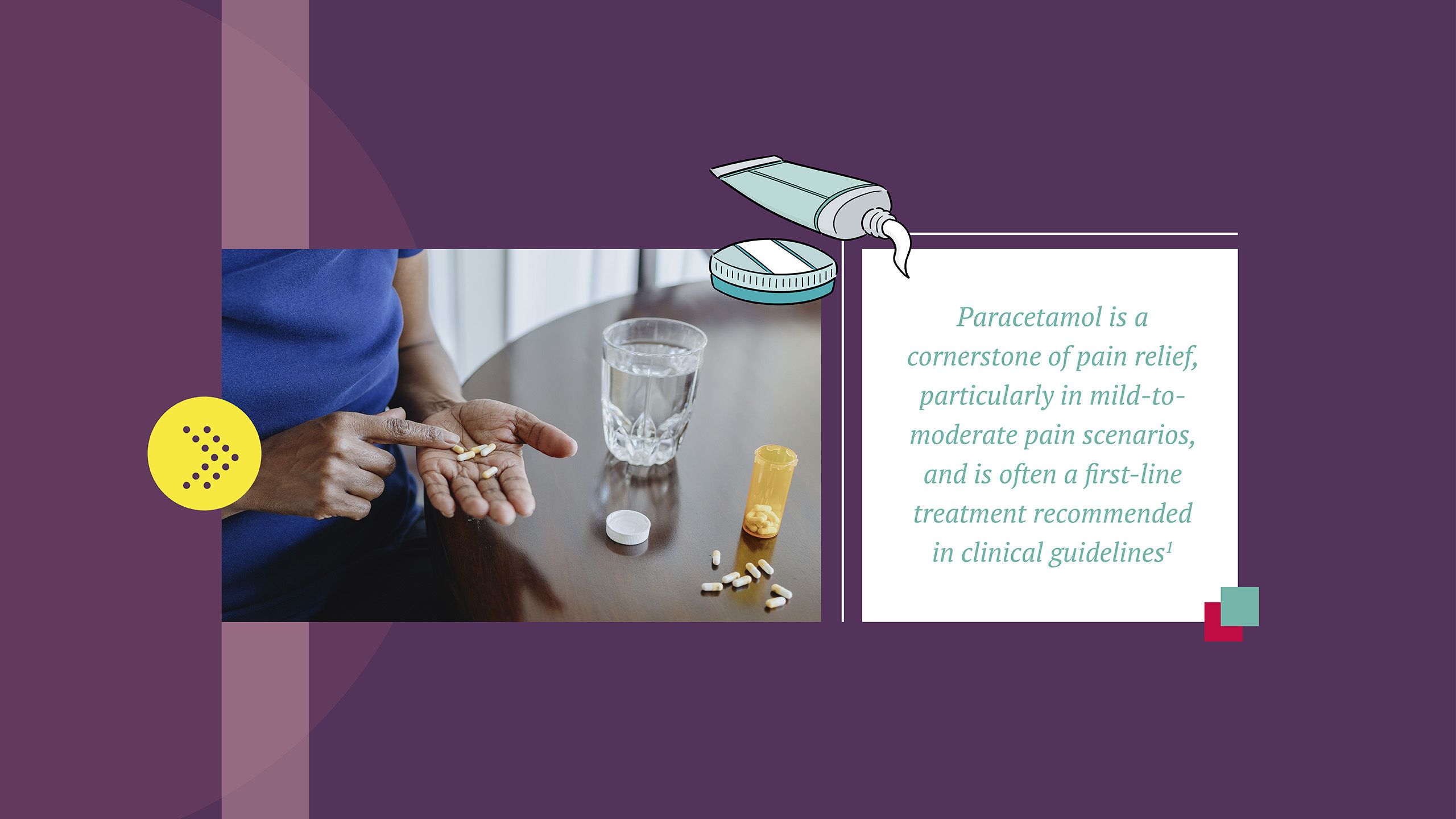
Paracetamol is one of the most widely utilised systemic analgesics due to its dual analgesic and antipyretic properties. It is a cornerstone of pain relief, particularly in mild-to-moderate pain scenarios, and is often a first-line treatment recommended in clinical guidelines.1 Its favourable safety profile stands out compared to NSAIDs and opioids, especially for populations at risk of gastrointestinal complications or opioid dependency. This advantage makes paracetamol a safe option for sensitive groups, including elderly patients and children.1,2
In paediatric populations, ease of administration is a critical factor. Formulations such as liquid syrups and dispersible tablets allow effective pain and fever management for those who may struggle with swallowing tablets.2 Paracetamol is not only versatile in its formulations but also effective in combination therapy. When used alongside NSAIDs or opioids, it enhances overall efficacy, allowing for reduced dosage of adjunct medications and lowering associated risks.1







TOPICAL SOLUTIONS: LOCALISED PAIN RELIEF
Topical treatments have gained prominence for their targeted action at pain sites and minimal systemic absorption. Menthol-containing formulations, for instance, offer significant relief by activating TRPM8 receptors, which create a cooling sensation and desensitise nerve endings.4,5 Such products are particularly effective for musculoskeletal pain, including muscle strains and joint discomfort, providing a safer alternative for patients who wish to avoid the side effects of systemic medications.3,4,5
Arnica gels have shown potential in pain management due to their anti-inflammatory properties, with compounds like sesquiterpene lactones modulating inflammatory pathways. While some studies suggest benefits for conditions such as osteoarthritis and sports injuries, clinical evidence remains inconsistent, and outcomes may vary depending on the formulation and specific condition being treated.6
MENTHOL PATCHES: ADVANCED TOPICAL DELIVERY
Menthol-based patches represent an innovative approach to localised pain relief, offering convenience and effectiveness for patients with chronic or acute musculoskeletal pain. These patches provide targeted treatment without the systemic risks associated with NSAIDs, such as gastrointestinal or renal toxicity. By desensitising nerve endings and reducing inflammation locally, menthol patches have been shown to significantly alleviate pain severity and improve quality of life metrics in studies. Patients often report high satisfaction with this treatment modality due to its ease of use and ability to reduce dependency on oral analgesics.3
COMPLEMENTARY ROLES AND MULTIMODAL APPROACHES
Incorporating systemic paracetamol7 with menthol-containing topical treatments4,5 aligns with the principles of multimodal analgesia by targeting different pain pathways simultaneously.8 Paracetamol acts centrally to reduce pain through COX enzyme inhibition,7 while menthol provides localised relief via peripheral sensory modulation through TRPM8 receptor activation.4,5 Although direct clinical evidence for this specific combination is limited, their complementary mechanisms support their use as part of a multimodal approach to managing mild-to-moderate pain.
For instance, in conditions like osteoarthritis, systemic paracetamol can address generalised discomfort,7 while menthol patches can provide localised relief at sites of joint pain4. This dual-action approach may enhance overall pain management by reducing reliance on high doses of systemic medications, thereby minimising associated risks. While further clinical research is needed to validate these combinations, tailoring multimodal regimens to individual needs represents a promising strategy to optimise pain relief and improve adherence.
Pharmacists play a pivotal role in educating patients about the appropriate use of such combinations, ensuring that treatments are both effective and aligned with individual medical histories. This is particularly crucial for populations requiring safer alternatives to NSAIDs, such as the elderly, those with cardiovascular risks, or patients managing chronic conditions.
Broad-spectrum pain management strategies that combine systemic and topical treatments represent an important shift toward safer, more individualised care. By leveraging the complementary strengths of agents like paracetamol and menthol or arnica, healthcare professionals can optimise pain relief while reducing systemic risks. As patient-facing experts, pharmacists are uniquely positioned to implement these strategies, guide medication choices, and enable better pain management outcomes.

REFERENCES
- Freo U, Ruocco C, Valerio A, et al. Paracetamol: A Review of Guideline Recommendations. J Clin Med. July 2021. Available from: https://pmc.ncbi.nlm.nih.gov/articles/PMC8347233/. Accessed September 2025.
- Okereke B, Ibeleme O, Bisi-Onyemaechi A. Randomised comparative trial of the efficacy of paracetamol syrup and dispersible tablets for the treatment of fever in children. J Int Med Res. March 2021. Available from: https://pmc.ncbi.nlm.nih.gov/articles/PMC7985941/. Accessed September 2025.
- Gudin JA, Dietze DT, Hurwitz PL. Improvement of Pain and Function After Use of a Topical Pain Relieving Patch: Results of the RELIEF Study. J Pain Res. June 2020. Available from: https://pmc.ncbi.nlm.nih.gov/articles/PMC7326193/. Accessed September 2025.
- Li Z, Zhang H, Wang Y, et al. The distinctive role of menthol in pain and analgesia: Mechanisms, practices, and advances. Front Mol Neurosci. October 2022. Available from: https://pmc.ncbi.nlm.nih.gov/articles/PMC9580369/#:~:text=Low%20to%20moderate%20concentrations%20of%20menthol%20activate%20TRPM8%20in%20the,menthol%20activates%20TRPM8%20to%20mediate. Accessed September 2025.
- Khan S. Menthol topical. MedicineNet. Available from: https://www.medicinenet.com/menthol_topical/article.htm. Accessed September 2025.
- Smith AG, Miles VN, Holmes DT, et al. Clinical Trials, Potential Mechanisms, and Adverse Effects of Arnica as an Adjunct Medication for Pain Management. Medicines (Basel). October 2021. Available from: https://pmc.ncbi.nlm.nih.gov/articles/PMC8537440/. Accessed September 2025.
- Freo U. Paracetamol for Multimodal Analgesia. Pain Management. April 2022. Available from: https://doi.org/10.2217/pmt-2021-0116. Accessed September 2025.
- Choi E, Nahm FS, Han WK, et al. Topical agents: a thoughtful choice for multimodal analgesia. Korean J Anesthesiol. 2020 Oct;73(5):384-393. doi: 10.4097/kja.20357. Epub August 2020. Available from: https://pmc.ncbi.nlm.nih.gov/articles/PMC7533183/. Accessed September 2025.
 Built with Shorthand